
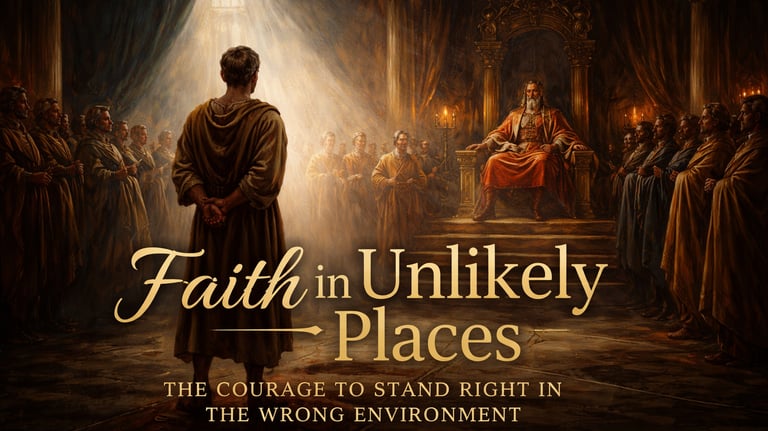
Faith in Unlikely Places: The Courage to Stand Right in the Wrong Environment
Why your environment does not have to determine your allegiance, and how God often works through those positioned within imperfect systems
Have you ever found yourself in a place where your values seemed out of sync with your environment, where the expectations around you subtly pulled in a direction that did not align with what you believed, and where the quiet pressure to adjust, compromise, or remain silent felt stronger than the conviction to stand firm?
Such situations are not uncommon, particularly in leadership contexts where individuals operate within systems that are complex, imperfect, and at times openly resistant to the principles they hold dear, yet Scripture reveals that this tension is neither new nor insurmountable, as it introduces us to individuals who navigated similar realities with clarity, courage, and unwavering devotion.
Two such figures, separated by time yet united in spirit, offer profound insight into what it means to remain faithful in environments that do not reflect one’s convictions.
Positioned Within, Yet Anchored Beyond
In 1 Kings 18, we are introduced to Obadiah, a senior official in the house of King Ahab, a ruler whose leadership was marked by moral compromise and sustained opposition to the ways of God, and yet the Bible makes a striking and deliberate observation about Obadiah’s inner life:
“Obadiah feared the Lord greatly.” (1 Kings 18:3, KJV)
This description is not incidental, because it establishes a clear contrast between his external environment and his internal allegiance, reminding us that proximity to compromised systems does not automatically translate into participation in them.
When Jezebel initiated a campaign to eliminate the prophets of the Lord, Obadiah responded in a way that required both conviction and courage, as he took one hundred prophets, hid them in caves, and sustained them with food and water, thereby preserving lives at great personal risk.
It is important to recognise, however, that Obadiah’s actions were not the result of fearlessness, because his later conversation with Elijah in verses 9–14 reveals a man who was fully aware of the danger he faced and genuinely concerned about the possibility of losing his life, which makes his actions even more instructive.
What we see in Obadiah is not the absence of fear, but the presence of a greater fear, because although he feared the consequences that could come from Ahab, he feared God more, and it was this reverence that ultimately governed his decisions.
Faithfulness Within a Hostile System
A similar pattern emerges in the New Testament when we encounter Joanna in Luke 8:3, described as the wife of Chuza, the manager of Herod’s household, which places her within a system that was no less hostile to the purposes of God than Ahab’s court.
Despite her proximity to power and her position within a politically charged environment, Joanna made a deliberate choice to use her resources and influence to support Jesus and His disciples, thereby aligning herself with a mission that stood in quiet opposition to the system she was connected to.
Her contribution may not have been as visibly dramatic as public preaching or prophetic confrontation, yet it was no less significant, because it enabled the continuity of ministry and demonstrated that influence does not always operate through visibility, but through intentional alignment with purpose.
When viewed together, the lives of Obadiah and Joanna reveal a consistent and powerful thread:
They feared God more than they feared the systems they served, and this fear shaped both their decisions and their impact.
Leadership Lessons for Today
These accounts, although rooted in biblical history, speak directly into modern leadership contexts, where individuals often find themselves navigating environments that are ethically complex, politically sensitive, or structurally misaligned with their convictions.
1. Your environment does not define your allegiance
Obadiah worked within Ahab’s administration, and Joanna lived within Herod’s system, yet neither allowed their surroundings to dictate their loyalty or reshape their convictions, which highlights a critical leadership principle that remains relevant today.
In contemporary settings, whether corporate, governmental, or institutional, there is often a subtle pressure to adapt in order to belong, to align in order to advance, and to remain silent in order to survive, yet Scripture reminds us that while your environment may influence your circumstances, it does not have to determine your allegiance.
True leadership begins with clarity about who you ultimately serve.
2. True character is revealed in hidden decisions
One of the most striking aspects of Obadiah’s actions is that they were largely unseen, as the prophets he protected were hidden in caves, away from public recognition, while Joanna’s contributions, though essential, did not place her at the centre of attention.
This reveals a deeper truth about character, which is that it is not formed in moments of visibility, but in decisions made away from public view, where there is no applause, no validation, and no immediate reward.
In leadership, this translates into choices that are often quiet yet significant, such as choosing integrity over convenience, protecting what is right even when it carries risk, and serving faithfully without the need for recognition.
3. Influence is not always visible, but it is always intentional
Neither Obadiah nor Joanna held what would traditionally be considered prominent spiritual roles, yet their actions had lasting impact because they positioned themselves as enablers of God’s work.
Obadiah preserved the lives of prophets who would continue to speak truth, while Joanna supported the ministry of Jesus in a way that sustained its operation, demonstrating that influence does not always require a platform, but it always requires intentionality.
This is particularly important in modern leadership, where visibility is often equated with significance, yet Scripture consistently shows that some of the most meaningful contributions occur behind the scenes.
4. Fear of God produces courage before men
The defining statement about Obadiah is that he “feared the Lord greatly,” and this fear, understood as reverence and alignment rather than terror, became the foundation for his courage, enabling him to act decisively in a context where silence would have been safer.
This principle remains profoundly relevant today, particularly in situations where leaders are pressured to conform, where truth becomes inconvenient, and where standing alone appears costly.
The question that ultimately defines such moments is not whether fear exists, but which fear takes precedence, because when reverence for God outweighs fear of consequences, courage becomes possible.
A Moment of Reflection
As you consider your own context, it may be helpful to reflect on the following questions with honesty and intention:
Where has your environment been subtly influencing your convictions in ways you may not have fully recognised?
What “hidden assignment” might God be entrusting to you that requires faithfulness without visibility?
Are you using your position as a platform for purpose, or are you allowing it to become a place of preservation?
These questions are not merely reflective, but directional, because they shape how you engage with both your environment and your responsibility within it.
Closing Thought
Obadiah and Joanna remind us that God often works through individuals positioned in unlikely places, not always by calling them out of the system, but by strengthening them to stand within it, and that in many cases, the greatest impact is not found in escape, but in steadfastness.
Their lives challenge the assumption that faithfulness requires ideal conditions, instead revealing that it often requires conviction in imperfect environments, where the tension between values and surroundings becomes the very space in which purpose is fulfilled.
“Be thou faithful unto death, and I will give thee a crown of life.” (Revelation 2:10, KJV)
Walk wisely. Live purposefully
Contact
want to recieve Our Biblical Reflections?
info@ancientpathsreflections.com
+447415265544
© 2024. All rights reserved.